Mapify vs MyLens AI: AI Tools for Visualizing Your Content
Compare Mapify for one-click mind maps with MyLens for generating complex clickable visuals and diagrams from your sources in seconds.
Mapify and MyLens both turn your content into visuals with AI—but they work differently. Mapify focuses on mind maps: paste a YouTube link, upload a PDF, or record audio, and it generates a structured mind map you can export. MyLens is a broader visual thinking platform: bring in your documents, spreadsheets, videos, and URLs, and it generates clickable timelines, flowcharts, mind maps, tables, and more—purpose-built for the complex diagrams (long mind maps, multi-step flowcharts, citation-linked visuals) that would take significant time to build manually.
If you’re choosing between them, it comes down to what you need. Want a quick mind map from a video, PDF, or audio file? That’s Mapify. Need AI to analyze your content and generate complex interactive visuals across multiple formats—fast, with automatic styling and easy chat refinement? That’s MyLens. This guide breaks down what each platform does, how they differ, and when to use which.
TL;DR
Mapify is a mind-map-first tool: paste a link, upload a file, or record audio, and it generates a mind map you can export—plus Deep Research for cited reports. MyLens is a native AI platform that automatically analyzes your sources, extracts insights, and generates complex clickable visuals—timelines, flowcharts, mind maps, tables, and more—all in seconds. If you need quick mind maps from content, Mapify works well. If you need complex interactive visuals across multiple formats, MyLens handles the analysis, design, and styling for you—like having an AI data visualizer by your side.
Try Yourself
Want to try Mapify? Head over to mapify.so to start mapping. Want to try MyLens? Give it a try right here for free — just type a topic or paste your content:
Quick Comparison: Mapify vs MyLens AI
| Feature | Mapify | MyLens |
|---|---|---|
| Primary focus | AI mind map summarizer: YouTube, PDFs, URLs, audio to mind maps | Interactive visual workspace: many visual types from your sources |
| Input types | PDF/Doc, YouTube, URLs, long text, audio, images; web search option | Documents, URLs, spreadsheets, images, YouTube, text |
| Visual types | Mind maps (plus slides from map; Deep Research adds cited report) | Mind maps, timelines, flowcharts, quadrants, tables, trees, and more |
| Interactivity | Edit and expand branches; chat with file; export when done | Click to expand, drill down, get explanations, view citations |
| Deep Research / deep analysis | Yes (Pro/Unlimited): cited report + synced mind map side by side | Yes: deep analyze for richer, more detailed visualizations |
| Export & share | Image, PDF, Markdown, link; slides; Xmind (Deep Research) | Interactive share; download; embed |
| Chrome extension | Yes | Yes |
| Pricing | Free tier; Pro and Unlimited (Deep Research on paid) | Free tier; paid plans for more |
What Is Mapify?
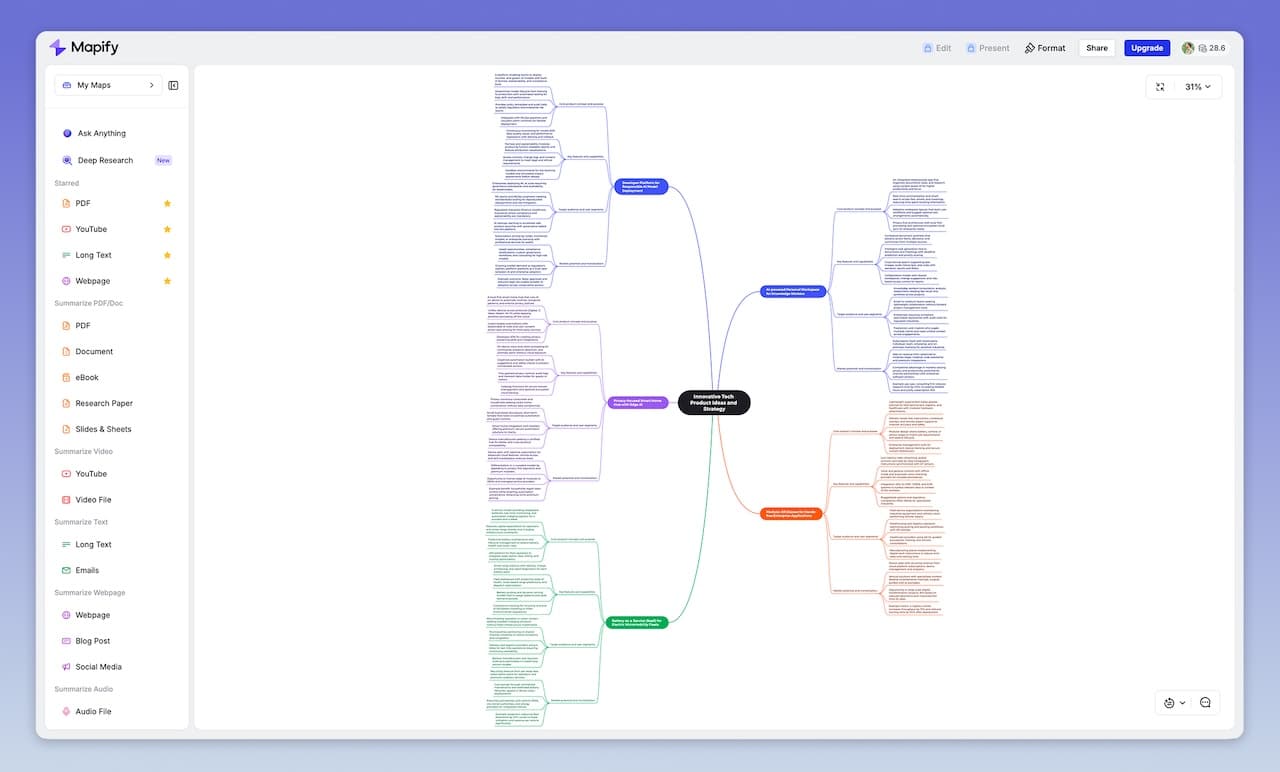
Mapify is an AI mind map summarizer that turns YouTube videos, PDFs and documents, URLs, podcasts, meeting recordings, and more into mind maps in seconds. It's powered by GPT, Gemini, or other top LLMs. You get one-click generation: paste a link, upload a file, or drop audio and Mapify produces a structured mind map. You can chat with your file to grasp content, expand ideas in one click, and use web-powered AI search to enrich the map with source links. Output can be translated into 30+ languages.
Mapify is built around the mind map as the main output. You customize and share by editing and formatting with keyboard shortcuts or clicks, then export as image, PDF, or Markdown or share via link. Additional features include turning mind maps into slides, an image generator to add illustrations to nodes, and AI templates for brainstorming, analysis, and planning. Mapify runs on web, mobile, and browser extension with synced maps. The company reports being trusted by over 5 million users.
Key Mapify Features
- One-click mind maps from PDF/Doc, YouTube, URLs, long text, audio, images
- Translate and summarize in 30+ languages; chat with your file
- YouTube to mind map with timestamps and auto transcription
- Ask Anything: web-powered AI search, expand ideas in one click
- Edit and format easily; export image, PDF, Markdown, or share link
- Present as slides; image generator; AI templates
- Cross-platform: Web, Mobile, Browser Extension
- Deep Research (Pro/Unlimited): cited report + synced mind map side by side
Mapify offers a free tier and paid plans (Pro, Unlimited); Deep Research is available on Pro and Unlimited. Check Mapify's website for current pricing and limits.
What Is MyLens?
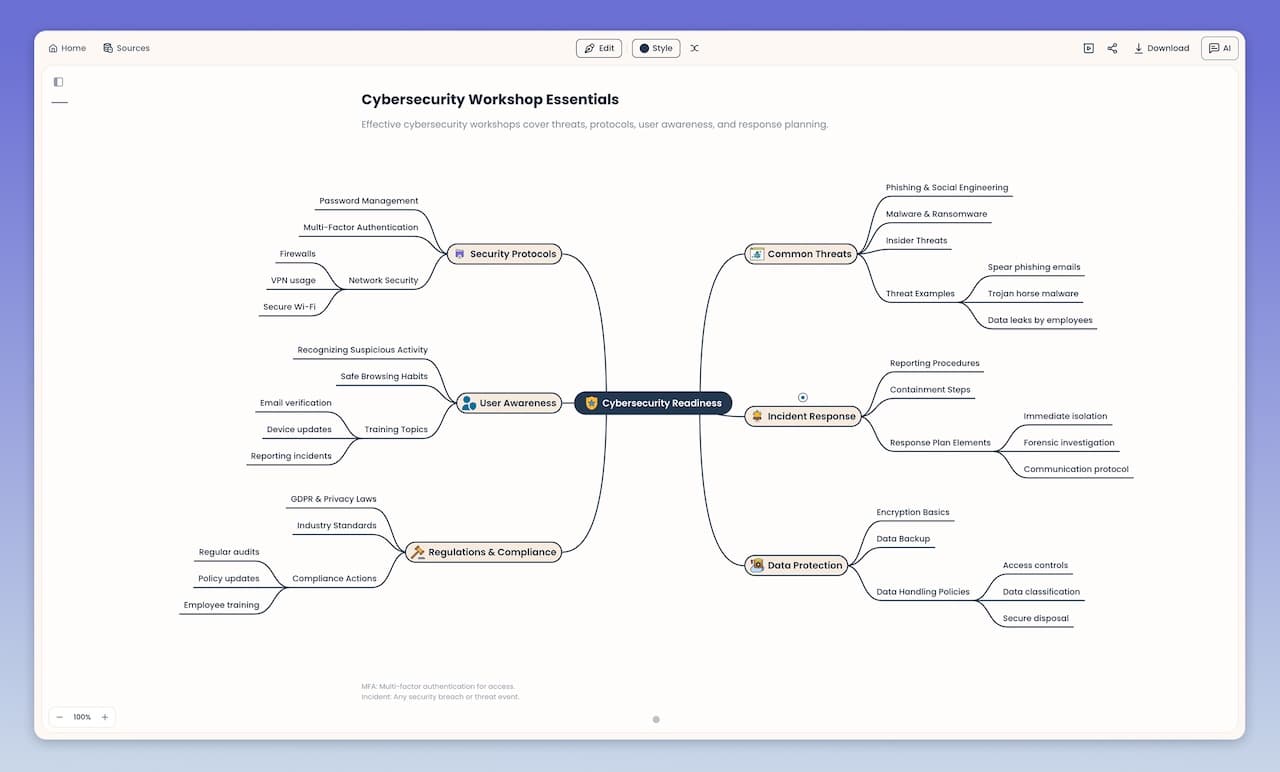
MyLens is a native AI visual thinking platform that transforms your sources and data into clickable, interactive visuals and diagrams. AI handles the heavy lifting automatically—analyzing your content, extracting key insights, choosing the right visual format, generating the diagram, and applying professional styling—so you go from raw content to a polished visual in seconds. You can expand nodes, drill down into sections, get explanations, view citations when you’ve uploaded sources, and generate infographics from any part. MyLens is built for complex, in-depth content—long mind maps, detailed flowcharts, multi-level timelines—not just simple summaries. You can also chat with the AI to refine anything—change the layout, add detail, restyle a section—and it updates your visual live, like having an AI data visualizer by your side. The result is a living diagram you can refine and then share or present.
MyLens supports PDFs, Word, PowerPoint, URLs, YouTube, spreadsheets (CSV, Excel), images, and plain text. You ask for a timeline, mind map, quadrant, flowchart, table, or other format; the AI suggests the best visual type and generates it. Every visual is fully editable by hand or with AI. The Chrome extension lets you visualize content wherever you are on the web—YouTube, websites, docs—just click MyLens.
Key MyLens Features
- Interactive Visuals: Mind maps, timelines, flowcharts, quadrants, tables, trees, and more—designed for complex, in-depth content
- Chat to refine: Ask AI to change layouts, add detail, restyle sections, or restructure your visual—it updates live, like having an AI data visualizer by your side
- Click to explore: Expand nodes, drill down, get explanations, view citations
- Fully editable: Manually adjust or ask AI to refine visuals
- Multi-format input: documents, images, spreadsheets, web, video, text
- Chrome extension: Wherever you’re on the web—YouTube, websites, docs—click MyLens to visualize content
- Multi-language support: generate visuals in any language
- Presentation-ready: share and present visuals easily
- Citation support: view source evidence when files are uploaded
MyLens is built for professionals analyzing business files, students turning study materials into visual summaries, educators creating lesson plans, and content creators organizing information for presentations.
See MyLens solutions and supported visual types.
Feature Comparison: Mapify vs MyLens AI
| Feature | Mapify | MyLens |
|---|---|---|
| Primary focus | Mind map summarizer from multiple inputs | Multi-format interactive visual workspace |
| Input types | PDF, Doc, YouTube, URLs, text, audio, images; web search | PDF, Word, PPT, URLs, YouTube, spreadsheets, images, text |
| Visual types | Mind maps; slides from map; Deep Research adds cited report | Mind maps, timelines, flowcharts, quadrants, tables, trees, and more |
| Interactivity | Edit, expand branches, chat with file; export deliverables | Expand, drill down, explain, infographic, view citations |
| Citations | Yes in Deep Research (report + map); chat with file uses content | Yes, when sources are uploaded (in-visual) |
| Deep Research | Yes (Pro/Unlimited): cited report + synced mind map | Yes: deep analyze for richer, more detailed visualizations |
| Slides / present | Present as slides from mind map | Share and present visuals |
| Export | Image, PDF, Markdown, link; Xmind for Deep Research | Interactive share; download; embed |
| Chrome extension | Yes | Yes |
| Multi-language | 30+ languages (translate/summarize) | Any language |
When to Choose Mapify
Choose Mapify when your workflow centers on mind maps and you want to summarize many input types quickly. It excels at one-click mind maps from YouTube, PDFs, documents, URLs, audio, and images, with optional Deep Research for cited reports on paid plans.
- Turning YouTube videos, PDFs, podcasts, or meeting recordings into mind maps in seconds
- Chatting with your file to understand content, then expanding branches with one click
- Using web-powered search to enrich mind maps with source links
- Getting a cited report plus a synced mind map via Deep Research (Pro/Unlimited)
- Presenting as slides derived from a mind map
If your workflow is "paste a link or upload a file, get a mind map, and optionally a cited report," Mapify is a strong fit.
When to Choose MyLens
Choose MyLens when you have scattered sources and need more than mind maps—timelines, flowcharts, tables, quadrants, and other visual types, all interactive and explorable. MyLens makes it easy to turn documents and data into professional visuals you can refine and present.
- Quickly transforming scattered sources (docs, data, videos, etc.) into professional visuals that highlight key points and relationships
- Understanding complex information at a glance through visual structures like timelines, mind maps, flowcharts, and tables
- Exploring interactively by clicking nodes to expand, drill down, get explanations, view citations, or generate infographics
- Discovering insights you might have missed and adding more information to visual nodes as you explore deeper
- Editing and personalizing visuals to make them yours, then presenting or sharing with your team or audience
If your workflow involves scattered sources that need to become structured, explorable, and presentable visuals—MyLens is built for that.
Key Differences: Mind-Map-First vs Multi-Visual Interactive
The fundamental difference between Mapify and MyLens lies in the scope and interactivity of their visual output:
Mapify: Mind-Map-First Summarizer
Mapify is built around the mind map as the primary output. You get fast summarization from many inputs into a mind map you can edit, expand, and export. Deep Research adds a second output—a cited, professional report—alongside a synced mind map. It’s ideal when mind maps are the main deliverable and you want speed, with optional cited reports on paid plans.
MyLens: Interactive Visual Structures
MyLens produces many visual types—mind maps, timelines, flowcharts, quadrants, tables, trees, and more—from the same source material. As a native AI platform, it handles everything automatically—analysis, insight extraction, visual generation, and styling—so you go from documents to a polished diagram in seconds. The visuals are living diagrams: click any part to expand, drill down, get explanations, and view citations. Where MyLens stands out is complexity and speed—long mind maps, multi-step flowcharts, in-depth timelines with dozens of events—the kind of detailed visuals that go well beyond a single mind map. And when you want changes, you just chat with the AI and it updates your visual live, like having an AI data visualizer by your side.
Pricing & Accessibility
Both Mapify and MyLens offer free tiers to try. Mapify has Pro and Unlimited plans (Deep Research requires Pro or above). MyLens has paid plans for higher usage and advanced features. For current pricing and limits, check Mapify and MyLens.
Related Articles
MyMap AI vs MyLens AI: AI Tools for Creating Diagrams
ComparisonsFebruary 19, 2026