Napkin AI vs MyLens AI: AI Tools for Creating Visuals
Compare Napkin for quick export-ready graphics with MyLens for generating complex clickable visuals and diagrams from your sources in seconds.

Napkin AI and MyLens both help you turn information into visuals with AI—but they shine at different levels of complexity. Napkin turns your text into polished, export-ready graphics you can drop into slides, posts, and docs—fast and minimal. MyLens uses AI to generate clickable, interactive visuals from your existing sources in seconds—purpose-built for the complex diagrams (multi-step flowcharts, long mind maps, citation-linked timelines) that go beyond a single static graphic.
If you’re choosing between them, it comes down to what kind of visual you need. Have text ready and want a polished graphic for a slide or social post? That’s Napkin. Have existing content and want AI to turn it into complex, explorable visuals you can share and present? That’s MyLens. This guide breaks down what each platform does, how they differ, and when to use which.
TL;DR
Napkin AI turns your text into polished, export-ready graphics for slides and social media—fast and minimal. MyLens is a native AI visual thinking platform—you bring in your documents, spreadsheets, videos, and URLs, and it generates complex, clickable visuals (multi-step flowcharts, long mind maps, timelines where you can click any part to see the source citation) in seconds—saving you hours of manual design. Choose Napkin for quick static graphics; choose MyLens for complex interactive visuals that help you understand and communicate information.
Try Yourself
Want to try Napkin AI? Head over to napkin.ai to start creating. Want to try MyLens? Give it a try right here for free — just type a topic or paste your content:
What Is Napkin AI?
Napkin AI is the visual AI for business storytelling. You import or paste your text—no prompting required—and Napkin generates relevant visuals so sharing your ideas is quick and effective. It works directly from your content: diagrams, mind maps, flowcharts, infographics, and data charts that you can pick, polish, and take anywhere.
Napkin is built for people who want visuals fast. You get full control over the result: add or swap icons from a large database, use decorators and connectors to emphasize structure, and adjust colors and fonts. Visuals are fully editable so you can make them yours before exporting. Creation and editing are desktop-focused; you can view existing Napkins on mobile, but the best experience is on desktop.
Key Napkin AI Features
- Text-first input: Import or paste text—no prompts needed; click to generate visuals
- Visual types: Infographics, diagrams, mind maps, flowcharts, data charts, and more
- Editable visuals: Icons, decorators, connectors, colors, and fonts
- Export formats: PPT, PNG, PDF, SVG (no JPEG; PNG for higher quality)
- Use cases: Presentations, blog, social media, and documentation
- Integrations: PowerPoint, Google Slides, Canva, Keynote; Medium, Substack, WordPress; LinkedIn, X, Instagram, YouTube; Google Docs, Word, Notion, Confluence
- Sharing: Export files or share a link so your audience sees text and graphics together
- Languages: Create visuals in 60+ languages (interface in English)
- Collaboration: Teamspace, real-time co-editing, commenting and feedback with built-in highlighter
Napkin offers a free plan with some limits on quotas and features; paid plans unlock more. Sign up on desktop via Google Single Sign-On or email and password. For support, use the chat widget on the website or email support@napkin.ai.
What Is MyLens?
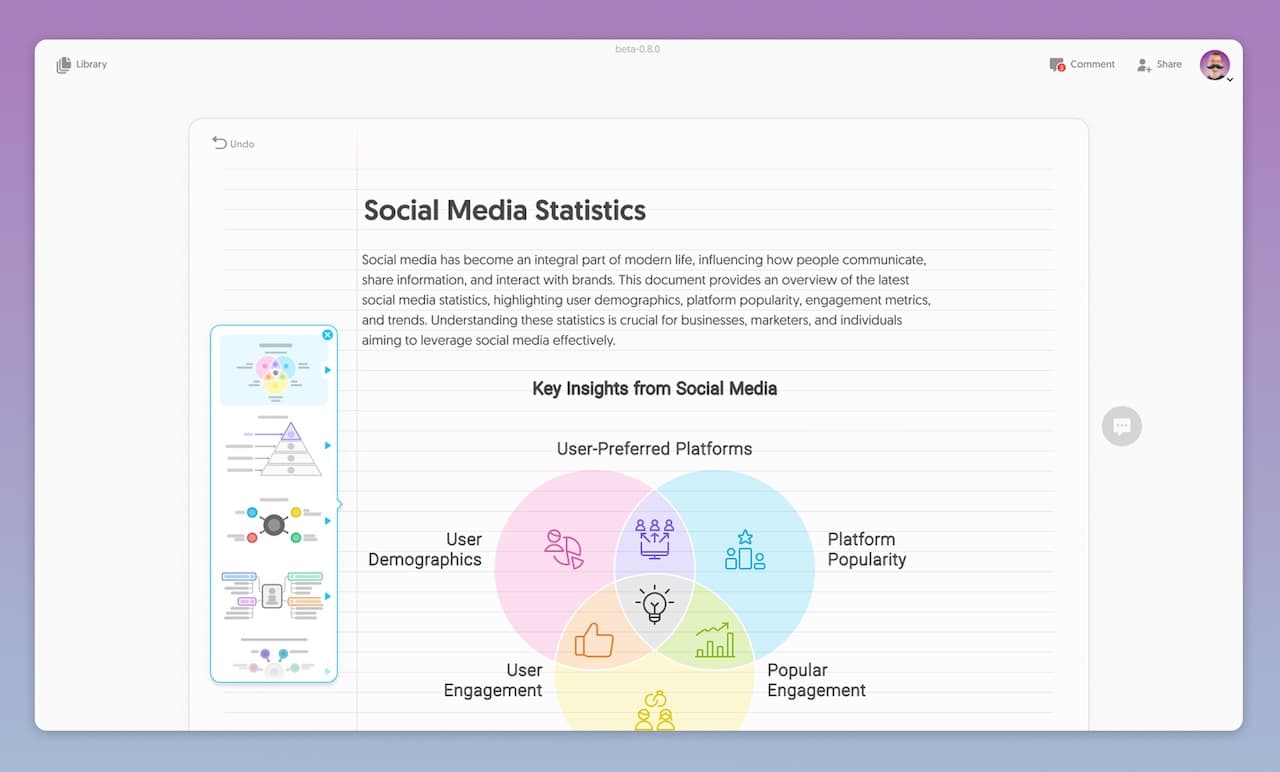
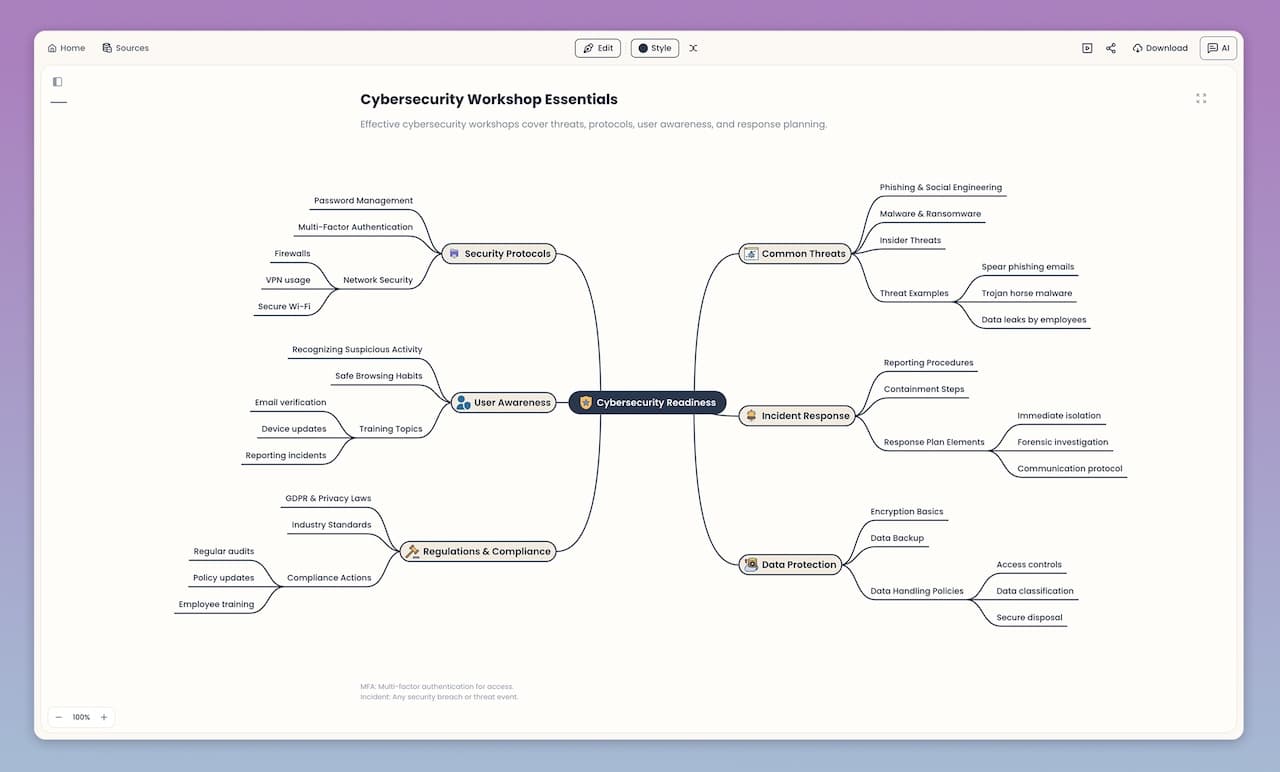
MyLens is a native AI visual thinking platform that transforms your sources and data into clickable, interactive visuals and diagrams. AI handles the heavy lifting automatically—analyzing your content, extracting key insights, choosing the right visual format, generating the diagram, and applying professional styling—so you go from raw content to a polished visual in seconds. The visuals are rich, interactive structures where you can expand nodes, drill down into sections, get citations from sources, generate infographics of any part, and get explanations. MyLens is built for complex, in-depth content—long mind maps, detailed flowcharts, multi-level timelines—not just simple summaries. You can also chat with the AI to refine anything—change the layout, add detail, restyle a section—and it updates your visual live, like having an AI data visualizer by your side. The result is a professional, shareable visual you can present or post.
MyLens supports a wide range of inputs: PDFs, Word, PowerPoint, URLs, YouTube videos, spreadsheets (CSV, Excel), images (including screenshots), and plain text. You can feed it meeting notes, reports, articles, or any content and ask for a timeline, mind map, quadrant, flowchart, table, or other visual format. The AI suggests the best visual type for your content and generates it automatically.
Key MyLens Features
- Interactive Visuals: Mind maps, timelines, flowcharts, quadrants, tables, trees, and more—designed for complex, in-depth content
- Chat to refine: Ask AI to change layouts, add detail, restyle sections, or restructure your visual—it updates live, like having an AI data visualizer by your side
- Click to Explore: Expand nodes, drill down, get explanations, view citations
- Fully Editable: Manually adjust content or ask AI to refine visuals
- Multi-format Input: Documents, images, spreadsheets, web content, videos, text
- Chrome Extension: Wherever you’re on the web—YouTube, websites, docs—click MyLens to visualize content
- Multi-language Support: Generate visuals in any language
- Presentation-ready: Compelling visuals that are engaging to present or post
- Citation Support: View source evidence when files are uploaded
MyLens is valuable for professionals analyzing business files, students turning study materials into visual summaries, educators creating lesson plans, and content creators organizing information for presentations.
Feature Comparison: Napkin AI vs MyLens AI
| Feature | Napkin AI | MyLens |
|---|---|---|
| Primary Focus | Fast visuals from text for export and sharing | Interactive visual thinking and exploration |
| Input | Import or paste text | Documents, URLs, spreadsheets, images, video, text |
| Visual Types | Diagrams, mind maps, flowcharts, infographics, data charts | Mind maps, timelines, flowcharts, quadrants, tables, trees, and more |
| Interactivity | Edit then export; static deliverables | Fully interactive: expand, drill down, cite, explain |
| Export | PPT, PNG, PDF, SVG | Interactive visuals; download, share, embed |
| Citations | Visuals generated from your text input | Click any node to view source citations from uploaded files |
| Browser Extension | Desktop-focused web app | Chrome extension for visualizing any webpage |
| Collaboration | Teamspace, real-time editing, commenting | Share and present visuals |
| Multi-language | 60+ languages for visuals | Any language |
When to Choose Napkin AI
Choose Napkin AI when your main need is quick, polished visuals for sharing and export. It fits:
- Presentations, blog, and social: You have text ready and want a visual in minutes to drop into decks, articles, or posts
- Export-first workflow: You need PPT, PNG, PDF, or SVG to use in other tools
- Business storytelling: You want auto-generated infographics, diagrams, and flowcharts that look good with minimal setup
- Team collaboration: You want Teamspace, real-time co-editing, and feedback on visuals
If your workflow is "paste text → pick a visual → polish and export," Napkin is a strong fit.
When to Choose MyLens
Choose MyLens when you have scattered raw data—documents, notes, reports, URLs, or other content—and need to turn it into interactive visuals you can explore and refine. It excels at generating timelines, mind maps, flowcharts, tables, and more that you can click into, expand, and cite. MyLens makes it easy to present or share these visuals with your team or audience.
- Transforming diverse sources (PDFs, Word, slides, URLs, spreadsheets) into one visual you can explore
- Understanding complex information at a glance through interactive structures
- Exploring by clicking nodes to expand, drill down, get explanations, or view citations
- Discovering insights you might have missed and refining visuals with AI
- Editing and personalizing visuals, then presenting or sharing in different formats
If your workflow involves multiple sources and you need structured visuals you can explore, cite, and iterate on—not just export once—MyLens is built for that.
Key Differences: Export-First vs Interactive Exploration
The main difference between Napkin AI and MyLens is how you use the visuals:
Napkin AI: Polish and Export
Napkin is built for speed and portability. You get visuals from text with no prompting, edit them with icons, decorators, and style options, then export as PPT, PNG, PDF, or SVG. The result is a finished asset you take into presentations, blogs, or docs. Ideal when the deliverable is a polished graphic and your input is already in text form.
MyLens: Interactive Visual Structures
MyLens turns your content into living diagrams you can explore. As a native AI platform, it handles everything automatically—analysis, insight extraction, visual generation, and styling—so you go from documents to a polished diagram in seconds. Visuals are clickable: expand any part, drill down, get explanations, or view citations. Where MyLens stands out is complexity and speed—long mind maps, multi-step flowcharts, in-depth timelines—the kind of detailed visuals designed for communicating rich, specific insights. And when you want changes, you just chat with the AI and it updates your visual live.
Pricing & Accessibility
Both Napkin AI and MyLens offer free plans to try. For higher quotas and more features, both have paid options. Check Napkin AI and MyLens for current pricing and plans.